The Date Is Not Wrong: How Moon, Sun and Community Set Sacred Observances
A community hall prints its festival programme for Tuesday. A family group chat says the observance begins Monday evening. A national holiday list marks Wednesday. None of those entries necessarily contains a typo.
A sacred date can be exact within its own tradition while producing more than one answer when translated onto a civil calendar. The apparent contradiction usually comes from several questions being compressed into one: What astronomical cycle defines the month? Is a new month observed or calculated? When does a day begin? Whose ruling applies in this place? And is the date on the notice a ritual observance, a public holiday or simply the most convenient day for a gathering?
Understanding those layers does more than solve calendar puzzles. It helps schools, employers, event organizers and neighbors avoid forcing communities into a false choice between their own practice and an administrative spreadsheet.
A sacred date often stays still while its civil date moves
When people say a festival “moves every year,” they usually mean that its position changes on the Gregorian calendar, the solar calendar used for most international civil business. Within the religious calendar, the observance may remain firmly attached to the same month and day, lunar phase, weekday or seasonal rule.
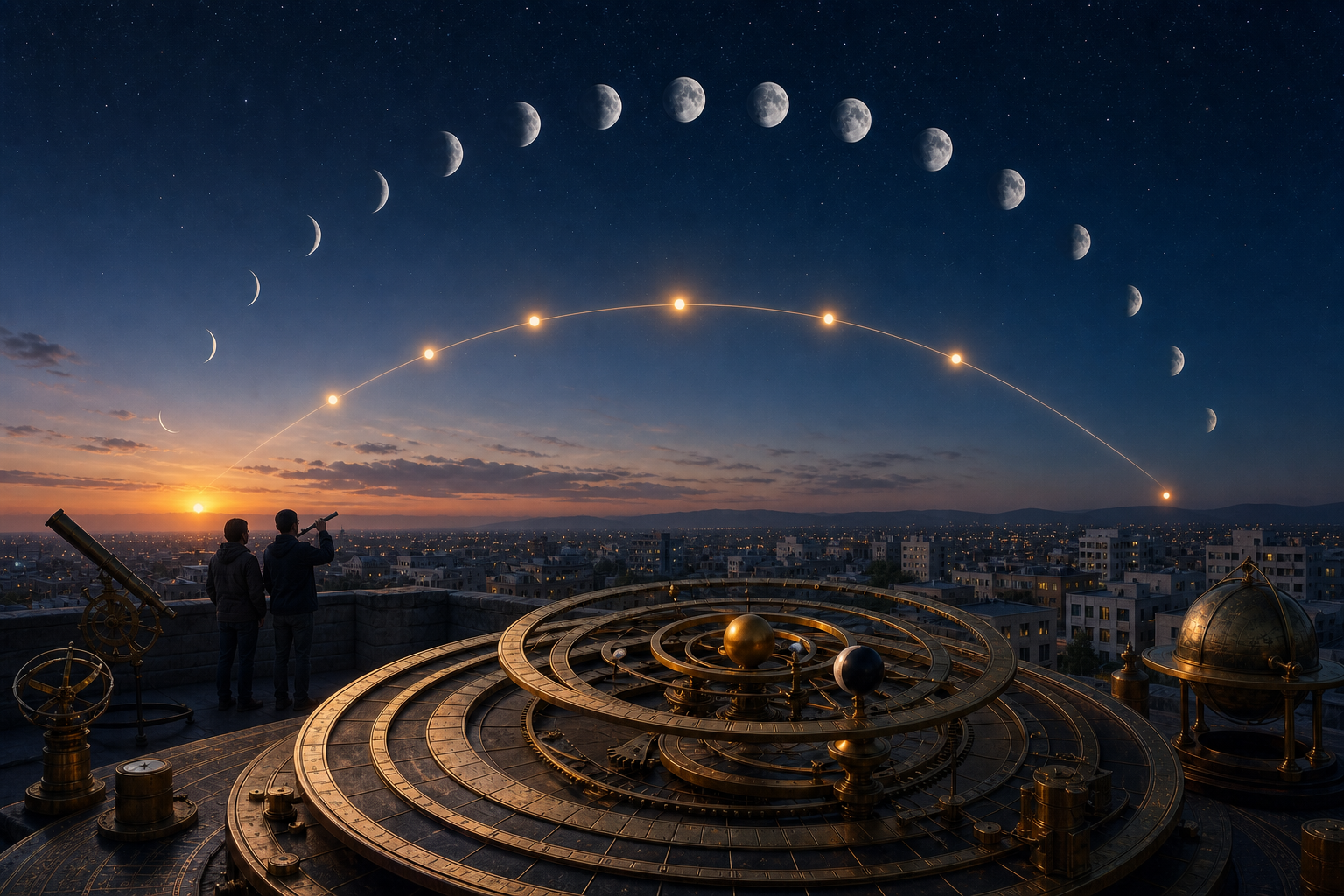
The mismatch begins with the sky. Earth’s seasonal year and the Moon’s phase cycle do not fit into a neat whole-number ratio. A tropical year is about 365.24 days. A cycle from one new Moon to the next averages about 29.5 days, so twelve such cycles total roughly 354 days. A twelve-month lunar year is therefore about eleven days shorter than a solar year.
Calendars resolve that mismatch in different ways:
| Calendar structure | What it follows | How it handles the mismatch | What users notice |
|---|---|---|---|
| Solar | The seasonal year | Adds occasional days or uses rules that approximate the year | Months stay in similar seasons |
| Lunar | Successive lunar months | Does not add a month to remain aligned with the seasons | Dates travel through the solar seasons over time |
| Lunisolar | Lunar months and the solar year | Adds a leap month, or otherwise adjusts the month sequence, when required | Dates shift within a range but remain connected to a season |
Intercalation is the general name for inserting time so a calendar remains aligned with its chosen cycle. The Gregorian leap day is one familiar form. A leap month is another. Neither is an improvised correction after a calendar “goes wrong”; it is part of the calendar’s design.
The new Moon and the first visible crescent are not the same event
Astronomers can calculate the instant of lunar conjunction—the configuration commonly called the astronomical new Moon—with great precision. At conjunction, however, the Moon’s illuminated side is directed mostly away from Earth, so it is not the slim evening crescent observers seek. The first crescent becomes potentially visible later, and visibility depends on geometry and conditions: the separation of Sun and Moon, the Moon’s altitude at sunset, latitude and longitude, atmospheric clarity, the horizon and the observer’s method.
That distinction explains why “science versus tradition” is a poor description of many calendar discussions. Calculation can identify when a sighting is possible or impossible. Observation can remain the religiously significant act. Communities may combine the two, use a formal visibility criterion, accept a report from a defined region, or follow a published calculated calendar. These are questions of religious method and authority as well as astronomy.
The Islamic calendar: one lunar framework, several valid methods of determination
The Hijri calendar is lunar. Its twelve months contain 29 or 30 days, and it does not insert a thirteenth month to stay with the solar seasons. Consequently, Ramadan and the two Eids occur about ten or eleven civil days earlier in many successive Gregorian years, eventually passing through all seasons.
It is misleading, though, to describe every Muslim community as using one identical global announcement. The start of a key month may be established through local crescent testimony, a national religious authority, astronomical visibility criteria, a sighting accepted from a wider region, or another recognized method. Jurisprudential views also differ over whether a sighting in one place should govern distant places.
Singapore’s Islamic Religious Council offers a concrete example of calculation serving a religious determination. It describes hisab, astronomical calculation, and rukyah, sighting, as two primary criteria used by scholars. Because local cloud and geography make sightings difficult, Singapore applies a reviewed crescent-visibility standard. The council also explicitly explains that different countries can reach different dates through methods valid in their respective contexts.
For an organizer, an estimated date from a generic app is therefore useful for reserving space, but it may not be the final community date. The responsible question is not “Which website is correct?” It is “Which authority does this community follow, and when will that authority confirm the date?”
The Jewish calendar: calculated months, seasonal anchors and evening beginnings
The Jewish calendar is lunisolar. Lunar months remain connected to the Moon, while intercalation keeps major festivals in their required seasons. Seven leap years in each nineteen-year cycle contain an added month; without that mechanism, a spring festival such as Passover would gradually migrate into winter and then autumn.
Because the modern calendar is calculated, its dates can be published far in advance. Yet a second translation issue remains: Jewish calendar dates begin in the evening, not at civil midnight. A calendar that labels Rosh Hashanah with a Thursday date may require leave, travel or meal planning beginning before sunset on Wednesday. Exact practice around sunset and nightfall can matter, so a local congregation is a better operational source than an all-day box imported into office software.
Diaspora and denominational practice add another layer. Some Jewish communities outside Israel observe an additional festival day, while practices in the Reform movement and other communities may differ. A human-resources calendar should not silently turn one community’s convention into a universal rule. It should let the participant state the period they actually observe.
Hindu calendars: the civil square cannot contain the whole tithi
“The Hindu calendar” is more accurately understood as a family of regional and traditional calendar systems. Many are lunisolar, while some regional systems give greater structural weight to solar months. Month conventions, locations and interpretive rules can differ even when communities recognize the same festival.
A central unit in many panchangas is the tithi, a lunar day defined by each 12-degree increase in the Moon’s longitude relative to the Sun. Thirty tithis make a lunar month, but a tithi is not a fixed midnight-to-midnight period. It can begin or end at any clock time because the apparent motions involved are not uniform. A festival rule may ask which tithi prevails at sunrise or during another prescribed part of the day. Location-specific sunrise, sunset and moonrise can therefore affect the civil-date mapping.
India’s Positional Astronomy Centre publishes the Rashtriya Panchang using modern astronomical calculations, including local solar and lunar times, tithis and other calendrical elements. Its history records why a standard reference was needed: many regional panchangas were in use after independence. A national reference can support civic coordination without erasing the regional or temple authority a particular community follows.
For a Hindu observance, copying last year’s Gregorian date forward is especially unreliable. Check a current panchang for the event location and then confirm the observance rule with the relevant temple, organization or family tradition.
Calculation itself can produce different calendars
Advance computability does not guarantee a single universal result. Easter is a useful Christian example. Its date is derived from a Sunday, an equinox rule and an ecclesiastical full Moon. Western churches generally use Gregorian tables; many Eastern churches use older tables associated with the Julian calendar, and practice among Eastern churches is not completely uniform. The “full Moon” in the traditional rule is tabular rather than simply the instant an astronomy app labels full Moon.
The Bahá’í calendar shows another carefully specified solution. It has nineteen months of nineteen days, plus four or five intercalary days. Naw-Rúz is tied to the vernal equinox, while the Twin Holy Birthdays follow a lunar rule within that solar framework. Its days run from sunset to sunset. The example matters because it resists a simplistic split between “solar calendars” and “moving religious dates”: one calendar can coordinate solar, lunar and sunset-based elements for distinct purposes.
Midnight is a civil convention, not the only possible edge of a day
Digital calendars usually store an event as a date beginning at 00:00. That interface hides a cultural assumption. Jewish and Bahá’í days run from evening to evening, and Islamic observance days also begin at sunset. A listing that says only “Friday” can omit a meaningful Thursday-evening beginning.
Sunset is local. London, Lagos and Los Angeles do not enter an evening-defined sacred date simultaneously. Even two cities sharing a civil time zone have different sunset times. Around the International Date Line, a worldwide observance can span different Gregorian labels while participants are faithfully keeping the same rule in their own locations.
This is not a reason to abandon exact schedules. It is a reason to store two kinds of information: the sacred-calendar identity of the observance and its local civil start and end times. “Begins at local sunset” is more informative than treating the event as an identical 24-hour block everywhere.
A verification workflow for organizers
A respectful calendar can still be practical. Use the following sequence before printing invitations, assigning shifts or booking travel:
- Name the community, not only the religion. Ask which congregation, mosque, temple, council or recognized calendar the participants follow.
- Identify the calendar rule. Determine whether the observance is fixed, calculated, sighting-dependent or tied to a local tithi, sunrise, sunset or other prescribed period.
- Separate tentative and confirmed dates. For an observation-dependent month, reserve a likely window and label it honestly. Do not present an estimate as a ruling.
- Record a real location and time zone. Use a city and an IANA time-zone name, not merely “evening” or a fixed UTC offset. Daylight-saving rules can change the conversion.
- Include the evening before when relevant. State both the civil date and the local start, such as “observance begins at sunset the previous evening.”
- Distinguish ritual dates from administrative dates. A government closure, school celebration or weekend community meal may be adjacent to, but not identical with, the sacred observance.
- Set an update channel. Tell attendees where a confirmation or change will appear and when the next notice is expected.
A compact planning record
| Field | Example of what to record |
|---|---|
| Observance | Name used by the participating community |
| Authority or source | Local council, congregation, temple or official calendar |
| Status | Projected, announced or confirmed |
| Boundary | Midnight, sunset, nightfall, sunrise or specified tithi period |
| Location | City plus time zone |
| Civil interval | Local start and end date-time |
| Next check | Named person, page or announcement time |
Suppose an interfaith center is planning a meal during a month whose start may depend on a crescent determination. It can reserve two possible evenings, publish an expected window, name the local authority it will follow and send the final notice after that authority announces the month. For a Jewish programme, it can show the sunset start rather than only the following civil date. For a Hindu event, it can consult a location-appropriate panchang and the hosting temple about the governing tithi. The process is consistent even though the traditions are not interchangeable.
Precision begins with humility
A calendar is not merely a neutral grid waiting for festivals to be placed inside it. It is a system for connecting astronomy, history, law, communal memory and daily life. Different answers can emerge because communities ask different calendrical questions—not because one side has ignored the sky.
The most accurate organizer is therefore not the person who finds one date fastest. It is the person who preserves the status of the date, the authority behind it, the boundary of the day and the place where it will be observed. That small discipline turns a potentially awkward scheduling problem into an act of informed welcome.
Source notes and further reading
- NASA Science: Moon Phases — the roughly 29.5-day phase cycle and why it differs from the Moon’s orbital period.
- Islamic Religious Council of Singapore: Determining Syawal — an official explanation of sighting, calculation, visibility criteria and independent national determinations.
- Reform Judaism: Leap Years in the Jewish Calendar and Jewish Holiday Dates — the nineteen-year intercalation cycle, evening beginnings and variation in diaspora practice.
- India Meteorological Department: Rashtriya Panchang — the official astronomical basis, local solar and lunar data, tithis and national reference calendar.
- VedicDateTime: An R Package to Implement the Vedic Calendar System — peer-reviewed technical treatment of tithi and location-dependent calendar conversion.
- U.S. Naval Observatory: The Date of Easter — ecclesiastical tables, calendar differences and the distinction between tabular and astronomical full Moons.
- The Bahá’í Calendar — the official calendar’s months, intercalary days, equinox rule, lunar exception and sunset-to-sunset day.