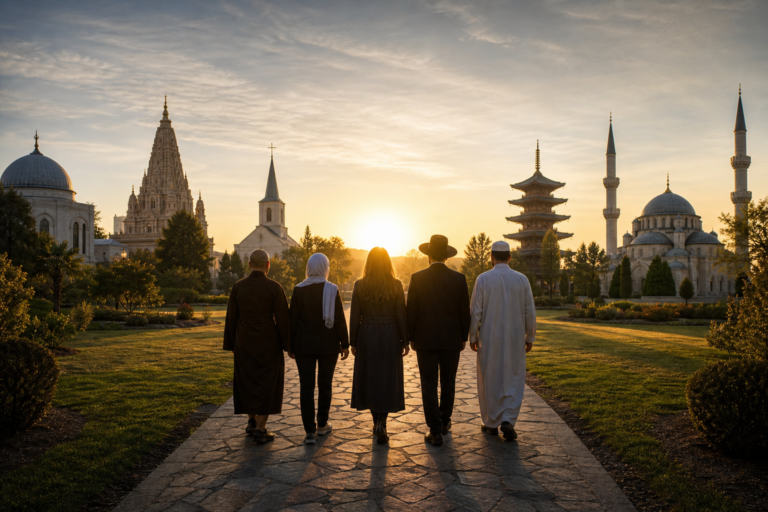

Visit a Spiritual Community Before Deciding Whether to Join
You can be interested in a spiritual community without knowing whether you want to join it. Perhaps you are returning to a tradition, exploring a different practice, or looking for people with whom to discuss questions that matter to you. A first visit can be an opportunity to learn rather than a decision about belonging.
Give the visit a modest purpose: understand what happens, how newcomers participate, and whether you would like to return. You do not need to settle your beliefs or share your personal history in one afternoon.
Ask what the visit will involve
Before attending, look for information intended for visitors or contact the organizer. Ask which gathering welcomes newcomers, how long it lasts, and whether any part requires prior knowledge or membership. A public talk, a worship service, and a small discussion group may offer very different experiences.
Practical details deserve attention. Ask about seating, step-free access, dress expectations, transport, and whether children can attend. If you need a quiet place or may have to leave early, describe that need directly. Clear information helps you decide whether the particular event is workable for you.
You can also ask, “May I observe without joining every activity?” Some practices may have boundaries connected to the tradition, while others may be open to everyone. Knowing the distinction lets you respect the community’s customs and make your own participation choices.
Choose what you want to share
Prepare a brief introduction that feels comfortable: “I am visiting to learn more about the group.” That is enough. You can mention your background if you want to, but curiosity does not require a detailed account of grief, family disagreements, health concerns, or previous religious experiences.
If someone asks a personal question, a simple response can preserve the conversation: “I would rather keep that private for now, but I am interested in how the gatherings work.” You can redirect toward the subject you came to explore.
Consider contact details in the same way. Before adding your name to a list, ask what it is used for and how often messages are sent. You may choose to receive event notices without agreeing to personal calls, group chats, or public introductions.
Notice how ordinary interactions work
The main speaker may leave a strong impression, but smaller moments can be equally informative. Notice whether an organizer answers a practical question clearly, whether newcomers receive usable explanations, and how someone responds when a participant declines an activity.
Distinguish unfamiliarity from a poor fit. A period of silence, a repeated phrase, or a formal sequence may feel unusual simply because it is new to you. Ask what it means before deciding what you think of it. At the same time, you do not have to override discomfort merely because others seem at ease.
Listen to how people describe disagreement. Is there room to ask about an idea without being expected to resolve the question immediately? You are gathering information about the particular group, not grading an entire religion or spiritual tradition from a single encounter.
Understand commitments before accepting them
A friendly invitation to return is different from a commitment to membership, volunteering, a course, or a regular payment. Ask what each invitation involves. Useful details include time, cost, cancellation arrangements, and any expectations beyond the activity itself.
If a donation is requested, clarify whether it is optional and whether a suggested amount is simply a suggestion. If there is a course fee, ask what is included. You can take written information away and consider it later instead of deciding while someone waits beside you.
For an ongoing role, ask who you would report to, how often you would be needed, and how to step back. These are reasonable questions about participation. A wish to contribute does not mean you already know how much time or responsibility you can offer.
Reflect before making the next plan
After leaving, make a few private notes while the details remain clear. Separate observations from interpretations. “The host explained how to leave the mailing list” is an observation. “They seem respectful of my time” is your interpretation of that and perhaps other experiences.
Consider three questions: what felt meaningful, what needs clarification, and what would make a second visit worthwhile? You might want another ordinary gathering, a conversation about one belief, or a different format. You might also decide that the group is not for you.
Allow the next step to remain small. Returning once does not require joining, and declining membership does not erase what you learned. A considered relationship with a spiritual community can begin with a visit whose boundaries and purpose are clear to you.