
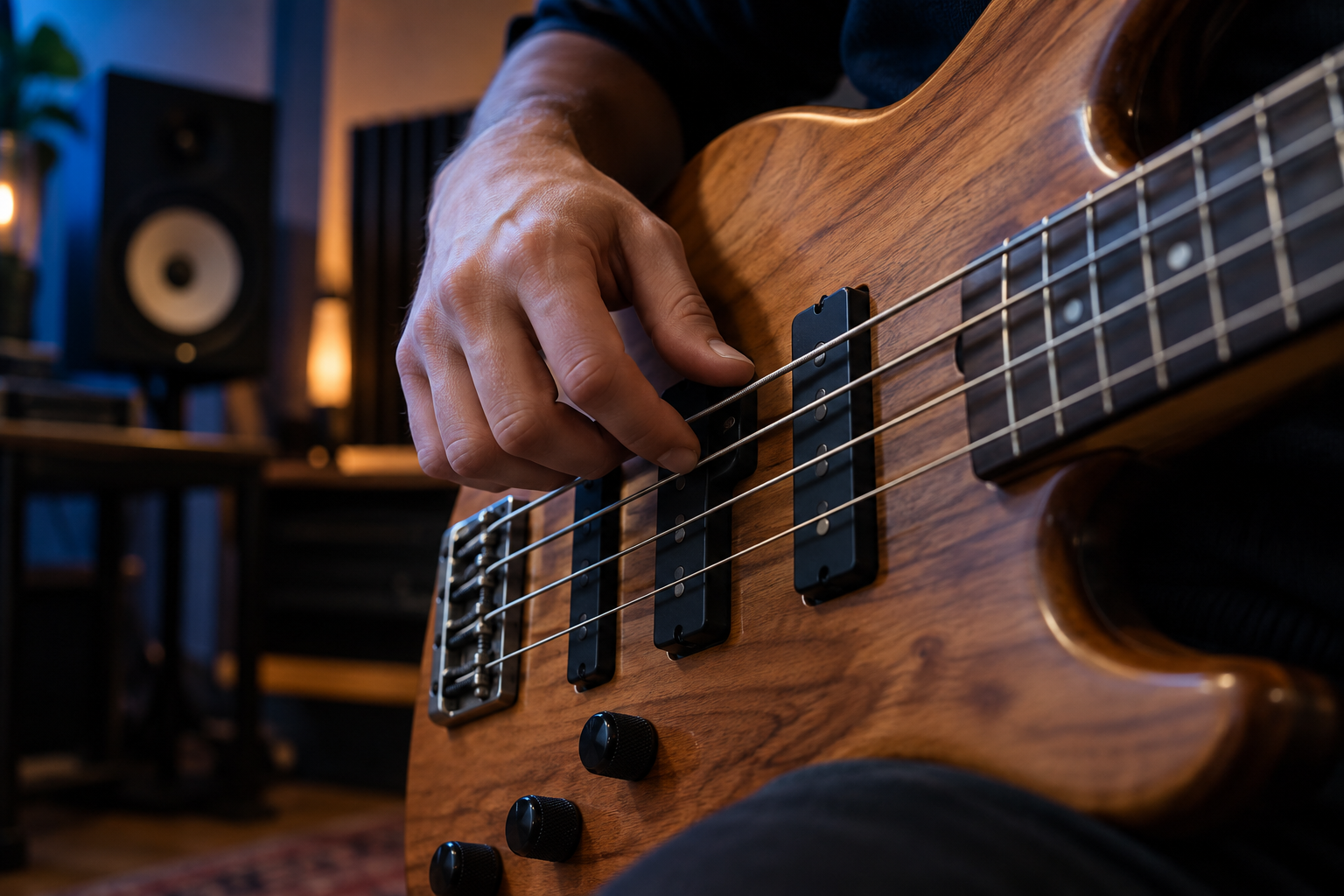
Follow the Bass: Hear a Familiar Song From a Different Angle
Choose a song you know well and listen for the part beneath the melody. It might be a rounded electric-bass sound, a plucked double bass, a synthesizer, or low notes on another instrument. Once you follow that part deliberately, familiar sections can begin to feel connected in a different way.
A bassline is a pattern of low-pitched notes. It often supports the harmony, meaning the way notes combine into chords, while interacting rhythmically with the drums. You do not need to identify the key or write notation to notice those relationships. Start with listening and plain descriptions.
Find the line before analyzing it
Play a short passage at a comfortable volume. Listen for a sound with a note you can roughly hum, moving underneath the vocal or lead instrument. Do not assume that every deep sound is the bassline. A kick drum can occupy a similarly low area while performing a different role.
The distinction is sometimes difficult because producers blend sounds or use long, pitched drum tones. If you cannot separate them immediately, describe the uncertainty instead of forcing an answer. Try another section where fewer instruments are playing, such as an introduction or a quieter verse.
Use the headphones or speakers you already have. If the lowest notes are difficult to hear, try a different listening position or a different playback device if one is available. Avoid compensating by turning the volume up sharply. The exercise should remain comfortable.
Listen once for timing
On the next pass, ignore the exact notes and follow when the bass sounds occur. Tap a steady pulse with one hand and notice where the bass enters relative to it. Does it land with the beat, arrive between beats, or hold a note across several pulses?
Then listen to the kick drum. Bass and kick may strike together, alternate, or meet only at selected moments. Describe what you actually hear: “They begin together, then the bass adds two shorter notes before the next drum hit.” That sentence is useful even without technical vocabulary.
Notice the ends of notes as well as their beginnings. A short, clipped bass sound leaves a different amount of space than a sustained note. Listen for gaps where the rest of the arrangement becomes more exposed. Silence can be part of the pattern you are following.
Listen again for movement
Now pay attention to whether the bass stays on one pitch or moves. You can sketch a rough line rising, falling, or remaining level. The drawing does not need to represent exact notes. It is simply a way to remember the direction of the phrase.
A repeated low note may make a passage feel grounded even while other parts change. A moving bass part may add a sense of travel. These are listening impressions rather than fixed rules: the effect depends on tempo, sound, harmony, and the rest of the performance.
Choose one moment where the bass changes note and listen to the music above it. Does the surrounding chord seem to change too? Does the bass connect two larger moments with a few brief notes? Ask the question first; exact harmonic labels can come later if you want to study them.
Compare the verse and chorus
Pick two recognizable sections of the same recording. A verse often carries changing lyrics, while a chorus is a recurring section that may contain the song’s central hook. These descriptions fit many songs, though plenty of music uses other structures.
Compare what the bass does in each section. It might become busier, move into a different register, hold longer notes, disappear briefly, or keep the same pattern. A register is simply an area of pitch: higher or lower within the instrument’s range.
If the bass stays constant while the chorus feels larger, listen for what changed elsewhere. Additional voices, percussion, or sustained chords may be responsible. Focused listening is useful partly because it helps separate the role of one part from the effect of the whole arrangement.
Return to the whole song
After several short passes, stop isolating the bass and play the track normally. Notice whether entrances or transitions now catch your attention. You may hear a familiar lift coming because you recognize the bass movement that prepares it.
Keep a brief listening note: the instrument or sound you think you heard, one rhythmic observation, one change between sections, and one question you could not answer. Avoid turning the session into a test with a pass mark.
Try the same exercise later with a contrasting song. A sparse acoustic recording and a dense electronic production will give you different problems to solve. The point is to build a habit of directing attention. A song you already enjoy can supply plenty to investigate once you choose a part and follow where it leads.