
The Rust Clock: How Water, Salt, Oxygen, and Design Decide When Metal Fails
Two steel brackets can leave the factory on the same day and look completely different five years later. One remains nearly unchanged beneath a dry interior shelf. The other develops orange streaks around a fastener within a season. Age is identical, yet the environments are not.
That difference reveals the central idea behind the chemistry of metal corrosion: rust is not a simple timer hidden inside iron. It is the visible result of an electrochemical system. Water helps ions move. Oxygen participates in a balancing reaction. Dissolved salts can make the liquid more conductive. Geometry decides where moisture and debris remain. Coatings, alloy choice and maintenance decide whether the system can keep operating.
The “rust clock” therefore speeds up, slows down and sometimes pauses. Reading it requires more than counting years or looking for orange color. It requires asking what circuit the metal and its environment have created.
Rust is one member of the larger corrosion family
Corrosion is the degradation of a material through interaction with its environment. Metals can corrode in different ways, producing different compounds and appearances. Rust refers more specifically to iron-containing corrosion products that form when iron or steel reacts in the presence of moisture and oxygen.
The familiar reddish-brown material is not one perfectly uniform substance. It can contain several hydrated iron oxides and oxyhydroxides, depending on conditions. Its texture may be powdery, layered or crusted. Unlike the tight passive film that protects some metals in suitable environments, ordinary rust often provides an incomplete, porous barrier. Moisture and oxygen can continue reaching metal beneath it.
Color alone is an unreliable measure of remaining strength. A broad stain may come from a small upstream fastener, while serious localized attack can hide inside a crevice or beneath a coating. Appearance is evidence to investigate, not a complete structural diagnosis.
The corrosion cell needs connected parts
Imagine a microscopic circuit spread across a steel surface. At an anodic area, iron atoms give up electrons and enter the surrounding moisture as positively charged iron ions. The released electrons travel through the metal toward a cathodic area, where a reduction reaction consumes them. In many ordinary oxygenated environments, dissolved oxygen participates in that balancing reaction.
The wet layer acts as an electrolyte, allowing charged species to move. The metal itself carries electrons between reaction sites. If the necessary paths are interrupted, the overall process slows. If moisture remains, conductive contaminants accumulate and favorable anodic and cathodic regions develop, corrosion can accelerate.
The anode and cathode do not need to look like separate components. They can be neighboring microscopic regions on one piece of steel. Differences in oxygen exposure, surface condition, stress, composition or contact with another metal can help establish the imbalance. Corrosion is local chemistry connected through a larger object.
Water is a pathway, not just a wet appearance
A perfectly dry surface denies the corrosion cell an easy ionic pathway. Real environments are rarely perfectly dry. Rain, condensation, wash water, humid air, soil contact and process fluids can create thin films that are almost invisible. A sheltered joint may remain damp long after an exposed face appears dry.
Duration matters. A brief clean-water splash that drains and dries is different from repeated wetting in a seam packed with debris. The seam stores moisture, concentrates dissolved material and reduces airflow. Each wet period gives the cell time to operate; each dry period can leave salts behind for the next event.
Condensation deserves particular attention because it can form without a leak. When a metal surface is cooler than the surrounding moist air’s dew point, water can collect on it. Pipes, ducts, roofs, cold-storage boundaries and outdoor equipment can therefore become wet from temperature conditions even when no rain reaches them.
Oxygen can create differences across one droplet
Oxygen supports common cathodic reactions, but more oxygen does not always mean that the most oxygen-rich spot becomes the area of metal loss. Under a deposit, gasket or stagnant droplet, oxygen may reach some regions more easily than others. The lower-oxygen region can become anodic relative to the better-aerated region and suffer localized attack.
This oxygen-concentration effect explains why crevices can be more dangerous than an evenly exposed surface. The outside may look well ventilated while chemistry inside the narrow gap changes. Dirt, scale, tape edges, overlapping plates and poorly sealed interfaces can all create small environments different from the surrounding air.
Cleaning and drainage are therefore chemical controls as well as housekeeping. Removing deposits and eliminating water traps changes the conditions that allow separate electrochemical regions to persist.
Salt presses the accelerator
Pure water conducts electricity relatively poorly. Dissolved ions increase conductivity, allowing charge to move through the electrolyte more readily. Salts brought by sea spray, road treatment, sweat, soil, industrial dust or cleaning residues can therefore accelerate corrosion conditions.
Chloride ions are especially troublesome for metals that depend on passive surface films. Chlorides can help destabilize those films and encourage localized forms such as pitting under suitable conditions. A surface may appear mostly intact while small sites penetrate more deeply than the average material loss suggests.
Salt also remains after water evaporates. Some deposits attract moisture from humid air, and repeated wet-dry cycles can concentrate contaminants. An object does not need to be continuously submerged to face an aggressive exposure. A coastal railing, vehicle seam or outdoor electrical enclosure can experience a series of short, chemically active wet periods.
Geometry writes the schedule
Design decides where the ingredients meet. A vertical smooth surface that sheds water behaves differently from an upward-facing ledge. A freely draining tube behaves differently from a capped cavity with one small entry point. A continuous accessible weld behaves differently from an overlapping joint that holds moisture but cannot be inspected.
Common rust-clock accelerators include pockets that trap rain, unsealed lap joints, absorbent material touching metal, dissimilar-metal contacts in a conductive environment, damaged coating at sharp edges, blocked drain holes and fasteners that create narrow crevices. The issue is not that every example will fail. It is that each can create a local environment more severe than the broad climate description suggests.
Good corrosion-aware design promotes drainage, ventilation, access for cleaning and inspection, compatible material choices and coating continuity. These choices are often easiest and least expensive before fabrication. Maintenance can compensate for some weaknesses later, but it cannot always make an inaccessible water trap observable.
Coatings work by breaking the circuit
A barrier coating separates metal from water, oxygen and contaminants. Its performance depends on preparation, adhesion, thickness, edge coverage, flexibility and continued integrity. A beautiful top surface cannot compensate for contamination or poor adhesion underneath.
Small coating defects can become important because they concentrate exposure at limited areas. Scratches, pinholes, cut edges and poorly coated welds deserve attention. Water that enters beneath a film can travel beyond the first visible blister, so the apparent edge of damage may not mark its chemical boundary.
Metallic coatings can add another mechanism. Zinc on steel, for example, can provide barrier protection and can preferentially corrode under certain conditions, helping protect exposed steel near a small defect. That benefit is not unlimited. Coating selection, thickness, environment and detailing still matter, and mixed-metal systems require informed design.
Dissimilar metals can redraw the cell
When different metals are electrically connected in an electrolyte, their electrochemical relationship can change which one corrodes more readily. This is often called galvanic corrosion. The effect depends on the particular materials, environment, area relationship and quality of the connection.
A small anodic area connected to a large cathodic area can be an unfavorable geometry because the corrosion demand is concentrated. That is why changing a fastener material without considering the surrounding assembly can produce an unintended result. Isolation washers, compatible materials, coatings and drainage may be parts of a solution, but details should follow an appropriate design for the actual service environment.
“Stainless” is also not a universal promise of immunity. Stainless steels rely on a passive chromium-rich film and can perform extremely well in suitable conditions, yet chloride exposure, crevices, temperature and grade selection can change performance. Material names are starting points, not complete environment specifications.
Build a five-part rust-clock map
For an asset, record five layers: material, exposure, geometry, protection and evidence. The map helps turn a vague instruction to “watch for rust” into a repeatable observation system.
- Material: Identify the base metal and, where known, alloy, fasteners, welds and connected metals. Do not assume every gray surface is the same material.
- Exposure: Note rain, condensation, salt, soil, chemicals, heat, cleaning methods and typical wetting duration. Include seasonal or operating changes.
- Geometry: Mark ledges, seams, cavities, low points, coating edges, drains and interfaces. Ask where water enters, where it travels and where it dries last.
- Protection: Record coatings, metallic layers, inhibitors, isolation components or other designed controls, along with their installation and renewal history when available.
- Evidence: Use dated photographs from consistent viewpoints, condition notes and measurements performed by qualified people when needed. Record change, not merely presence.
The map should also identify consequence. Corrosion on a decorative non-load-bearing item is not managed the same way as corrosion on a pressure boundary, electrical enclosure, vehicle component, stair, balcony, lifting device or primary structure. Higher consequence demands a lower threshold for competent assessment.
A simple demonstration makes the chemistry visible
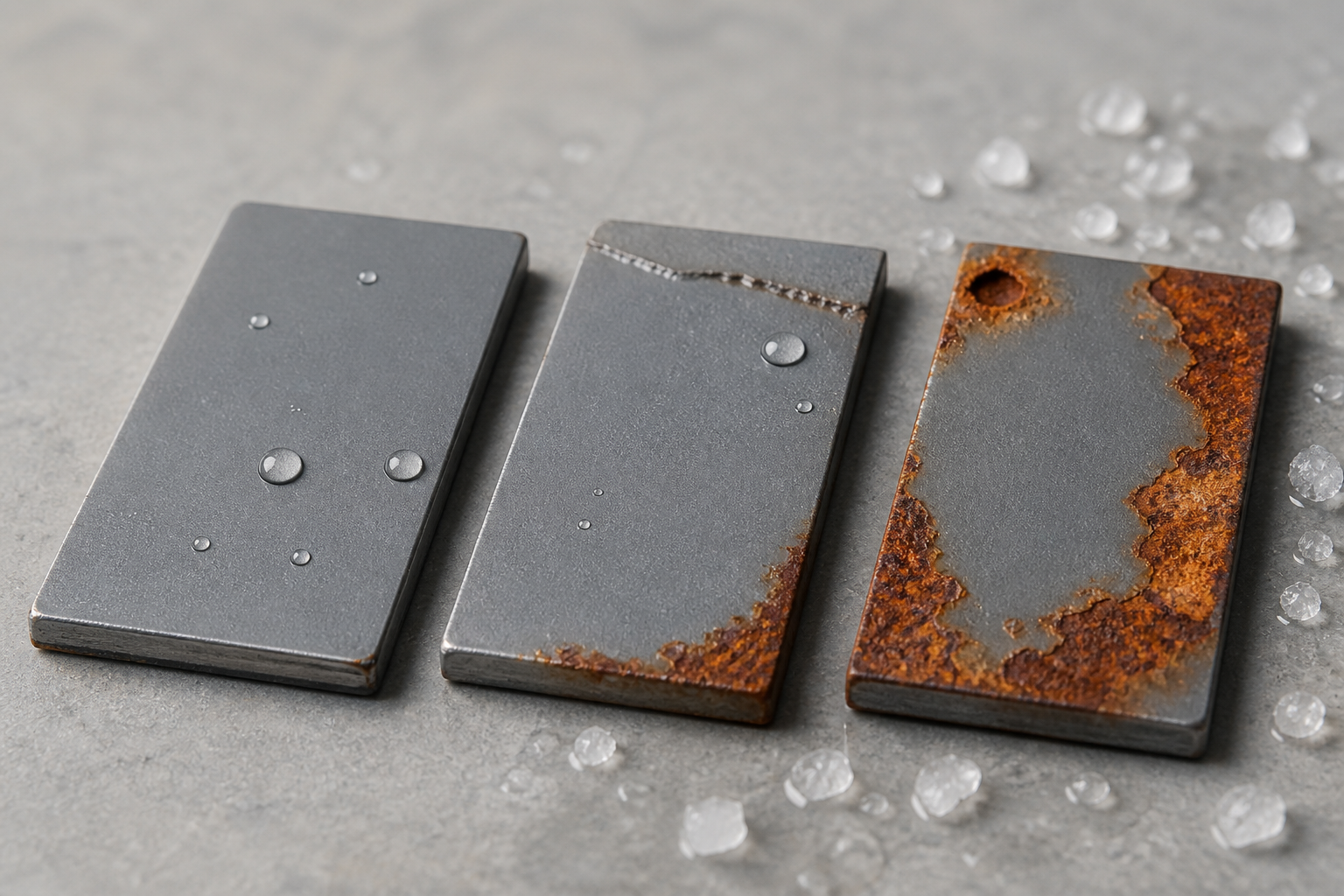
A supervised classroom-style comparison can show why exposure matters. Identical plain-steel samples can be placed in clearly labeled, non-food containers under different controlled conditions: kept dry, exposed to clean water, and exposed to a mild salt-water solution. Observations at consistent intervals can record color, location and spread without claiming precise corrosion rates.
Use eye protection and gloves as appropriate, keep samples away from children and food areas, avoid sharp edges, and follow local rules for handling and disposal. Do not mix household cleaners, acids or unknown chemicals. The demonstration is qualitative: it does not reproduce real alloy specifications, stresses, coating systems, temperatures or service loads.
Its useful lesson is not simply that salt water “wins.” Watch where droplets remain, where air reaches the surface, how deposits form and what happens during drying. The pattern reveals an environment evolving over time.
Inspection should track change without causing damage
Start with safe visual observations from accessible positions. Look for coating breaks, staining paths, blistering, deposits, persistent dampness, blocked drainage, section loss, loose scale and changes around connections. Photograph the same area with a size reference that does not hide the surface.
Do not aggressively scrape, grind, hammer or chemically clean a critical component merely to see what lies beneath. Those actions can remove evidence, damage protective systems, release hazardous material or weaken a compromised part. Coatings on older assets may also contain substances that require controlled handling.
When condition affects structural capacity, pressure containment, electrical safety, transportation, fall protection or another high-consequence function, use a qualified professional and the applicable inspection standard. Surface appearance alone cannot determine remaining thickness or fitness for service.
Control the ingredients, then verify the result
Corrosion control can involve material selection, environmental control, drainage, sealing, protective coatings, metallic coatings, inhibitors, electrical isolation or engineered cathodic protection. The correct combination depends on the asset and exposure. A method that helps one system can damage another when applied without compatibility checks.
Maintenance closes the loop. Keep drains open, remove deposits using approved methods, repair coating defects under a suitable procedure and investigate the moisture pathway rather than repeatedly covering the stain. After work, observe the area through comparable wet and dry conditions. A repair is not proven by fresh paint on the first day.
The rust clock is ultimately a model for better questions. Where is the anode likely to form? How can ions and electrons travel? What keeps the surface wet? Where does oxygen differ? What contaminants concentrate? Which design detail makes inspection difficult? Which protective layer is carrying the load?
Metal does not fail because a calendar page turned. It changes because a chemical circuit found the ingredients and time to operate. Alter those conditions, make hidden geometry visible and track evidence consistently, and the clock becomes something that can be understood rather than merely watched.