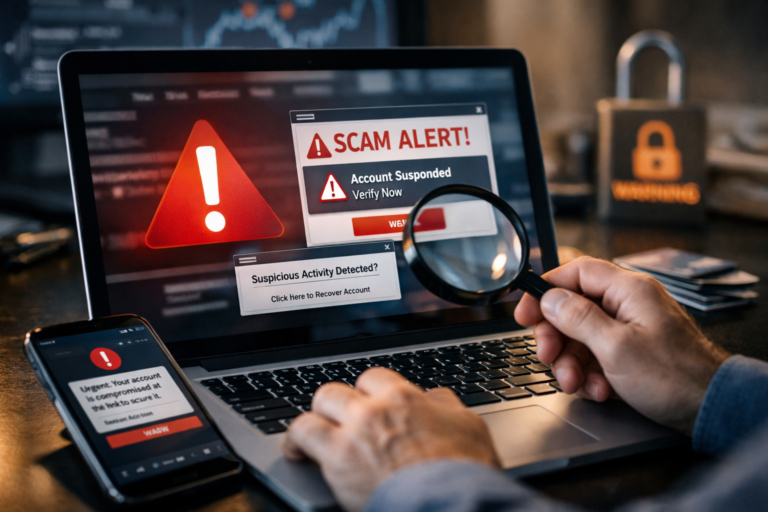

The Second Trap: How Recovery Scams Target People Who Have Already Lost Money
The first loss is painful enough. A payment has disappeared, an investment story has collapsed, an account has been misused or a promised purchase never arrived. Then, while the person is still trying to understand what happened, someone appears with unusually welcome news: the money has been found.
The new caller may claim to be an investigator, lawyer, government representative, blockchain specialist, consumer advocate or employee of a compensation program. The approach can sound informed. It may mention the original company, the approximate loss, the payment method or even a complaint that the victim filed. There is only one obstacle, the caller says: a fee, tax, bond, deposit, account credential or remote-access session must be provided before the funds can be released.
This is the pattern behind recovery scams after fraud. The second scheme does not begin with a blank page. It begins with a real loss, real records and a person’s reasonable hope that some of the damage can be repaired. That borrowed reality can make the second trap feel more credible than the first.
Why the period after a scam creates a new risk window
After a financial shock, several demanding tasks arrive at once. The victim may need to contact a bank, change passwords, preserve messages, explain the event to relatives or colleagues and decide where to report it. The facts may still be incomplete. Shame, anger and urgency compete for attention. A confident stranger who promises to take over the hard work can therefore feel like relief.
The first scam may also have produced a useful profile for criminals. The people involved may already know a name, telephone number, email address, approximate loss, favored communication channel and the story that persuaded the person to pay. That information can remain with the original group, move to an associate or be traded in a list. A second approach can be personalized without the caller possessing any genuine recovery authority.
Public action can create another route. A person may post about the loss, comment beneath a warning video, join an online group or place details in a public complaint. Impostors monitor those spaces and reply with supposed experts. The reply appears connected to the victim’s own search for help, which can disguise the fact that the relationship began with an unsolicited approach.
The recovery story is built around borrowed facts
A persuasive recovery scam mixes information the victim recognizes with claims that are difficult to verify. The real company name is paired with a fictional court order. A genuine transaction identifier is paired with a fabricated tracing report. A public agency’s name is paired with a false department. The presence of one accurate detail can make the entire package seem authenticated.
Case numbers, seals, letterheads, screenshots and formal vocabulary are inexpensive to manufacture. A dashboard may display a balance that cannot actually be withdrawn. A document may announce that money is “frozen,” “escrowed” or “awaiting clearance.” A caller may transfer the conversation between an investigator, supervisor and finance officer, even though all three identities belong to the same operation.
The safest question is not, “How much do they know about my case?” It is, “Can I establish this person’s identity, authority and claim through a route that they do not control?” Knowledge about the first loss proves access to information. It does not prove possession of recovered funds.
Notice the fee that keeps changing its name
The payment request may be called a retainer, processing charge, tax, insurance premium, anti-money-laundering bond, wallet activation, court filing cost or refundable security deposit. The label changes because the emotional purpose is the same: make one more payment appear small beside the amount supposedly waiting.
Once the first fee is paid, another barrier often appears. A signature was incomplete. A transfer exceeded a threshold. A foreign authority requires certification. The account needs additional liquidity. Each payment is framed as the final step, while the promised recovery remains just out of reach.
Payment method matters too. An insistence on cryptocurrency, gift cards, cash, wire transfer or another difficult-to-reverse channel is a serious warning. So is an instruction to misdescribe the purpose of a payment, split it into smaller amounts or hide it from a bank employee or family member. A legitimate process should survive accurate disclosure and independent review.
Guarantees are not evidence
No outsider can responsibly promise that every loss will be recovered. Outcomes depend on what happened, how payment was made, how quickly action began, which organizations and jurisdictions are involved, what assets remain and what legal or contractual remedies apply. Even a qualified professional cannot manufacture reachable assets or guarantee that a provider will reverse a transaction.
Be cautious when a representative claims a perfect success rate, sets an immediate expiration, says the case is already won or refuses to describe the work that will be performed. A real engagement should make the scope visible. The client should be able to understand which actions are included, what each fee buys, who holds responsibility and which outcomes remain uncertain.
Promises can also be disguised as technical certainty. A person may say that a digital asset has been “located on the blockchain,” implying that location equals control. Public transaction visibility does not by itself establish that a private party can seize, reverse or return funds. A colorful tracing diagram is not a transfer authority.
Build a recovery firewall before answering offers
A recovery firewall is a set of rules that separates genuine response work from anyone trying to enter through the crisis. It does not require abandoning hope. It creates a controlled path for evaluating help.
Use one case coordinator
Choose one person to maintain the timeline and communication log. This can be the affected person, a trusted relative or an authorized employee. The coordinator records who made contact, when, through which channel, what organization was claimed and what was requested. Other household or team members forward approaches instead of starting separate conversations.
Centralization prevents an impostor from telling different stories to different people. It also reduces repeated disclosure of personal information and helps legitimate banks, advisers or authorities receive a coherent account.
Separate the claim from the contact route
Do not verify a caller by using the telephone number, link, email domain or reference provided in the caller’s own message. Find the organization independently through a statement already held, an authenticated account, a known regulator directory or another established channel. Then ask whether the organization contacted you and whether the named person, case and department exist.
Caller identification, a professional-looking website and a familiar logo can be copied or manipulated. Verification is stronger when the person being checked does not control the route used for checking.
Adopt a no-unplanned-payment rule
No recovery-related payment should be made during the first contact. Require a written scope, a complete fee schedule and time for independent review. For a household, that may mean discussing the offer with a trusted second person. For an organization, it may require legal, finance and security review under existing purchasing rules.
A pause is especially important when the representative says secrecy is necessary or warns that verification will cause the money to vanish. Genuine urgency may exist in contacting a payment provider after fraud, but that urgency does not require paying an unsolicited rescuer.
Protect the evidence file
Keep original messages, headers where available, payment confirmations, receipts, account notices, telephone numbers, usernames and a dated narrative. Store working copies securely and limit access. Do not send the entire file to a stranger merely because the stranger knows one fact about the case.
Share only what a verified recipient needs through an appropriate channel. Identity documents, recovery codes, passwords and one-time authentication codes require particular care. A person offering help does not need control of the victim’s email, device or financial account to explain a proposed service.
Follow the legitimate response path first
If money was sent through a bank, card, payment application, wire service, gift card company or digital-asset platform, contact that provider promptly using established details. Describe the transaction accurately, say that fraud is suspected and ask what protective or reversal steps may still be available. Speed can matter, but success is never assured.
Secure exposed accounts from a device believed to be safe. Change compromised passwords, beginning with email accounts that can reset other services. Review recovery addresses, multifactor settings, active sessions and forwarding rules. If remote access was granted, seek qualified technical help before using the device for sensitive changes.
Use the reporting channels that apply to the location and incident. These may include a financial institution, employer security team, consumer-protection body, securities regulator or law-enforcement reporting service. Rules and available remedies differ, so an official local route is more reliable than a stranger who arrives in a direct message.
Evaluate paid professional help without suspending judgment
Some victims may reasonably consider a lawyer, licensed investigator, forensic specialist or other professional. The title alone does not settle the question. Check the person and organization through the relevant independent registry or professional body where one exists. Confirm the office using separately obtained details and examine whether the claimed license or registration covers the service offered.
Ask for a written explanation of the work. Will the professional analyze transactions, preserve evidence, communicate with a provider, prepare a claim or begin legal proceedings? Which tasks can the client perform directly? How are fees calculated? What happens if no assets are found? Who will hold sensitive data, and for how long?
A legitimate provider should be able to discuss limitations without turning every question into pressure. Local legal advice may be necessary for deadlines, court remedies or cross-border issues. This article cannot determine whether a particular service or claim is lawful, qualified or suitable.
If the second payment has already been made
End the contact and do not send an additional payment to “unlock” the first one. Contact the company used to send the money and explain that the transaction was connected to fraud. Ask what actions are possible for that payment method. Preserve the recovery approach as a second incident, including new accounts, wallet addresses, documents and conversations.
Review what else was exposed. If identity information was shared, follow the appropriate identity-protection process for the relevant country. If credentials or remote access were provided, secure accounts and devices through trusted channels. Warn other people involved in the original case because the impostor may approach them with related details.
Do not let embarrassment delay action. The second scheme was designed for someone already carrying the pressure of the first. Clear reporting and accurate records matter more than proving that every decision was perfect.
Separate a case update from a demand for action
A real institution may sometimes communicate about a complaint, investigation, insolvency process or refund. The existence of legitimate updates is exactly why a blanket rule to ignore everything is unhelpful. Instead, split the message into two questions. First, can the case update be confirmed through an established account, published case record or independently reached office? Second, does the requested action make sense for that verified process?
Do not let a correct case reference answer both questions. An impostor can repeat public or stolen information and then attach a false payment instruction. Re-enter the process through the channel originally used to file the complaint, or through contact details obtained independently. Ask what information is actually required, how it should be submitted and whether any fee exists. If the message says a deadline applies, confirm the date and consequence without using its reply button or telephone number.
This separation also helps families and teams communicate clearly. A log can mark the update itself as confirmed, unconfirmed or false, while recording each requested action separately. That prevents one authentic detail from granting automatic trust to every instruction that follows.
Recovery should reduce uncertainty, not manufacture it
Genuine response work turns a confusing event into defined tasks: contact the payment provider, secure access, preserve evidence, report through applicable channels and evaluate qualified help carefully. A recovery scam moves in the opposite direction. It introduces secret departments, unexplained fees, artificial deadlines and one final obstacle after another.
The most protective habit is to treat every unexpected recovery approach as a new claim, not as proof that the old money has returned. Record it. Pause. Rebuild the contact route independently. Ask what authority exists and what exact work will occur. Refuse payment methods or access requests that remove control.
Hope is not the weakness these schemes exploit; isolation and compressed decision-making are. Bring another trusted person into the process, keep the evidence organized and use channels that can be verified without the claimant’s assistance. The first loss deserves a careful response. It should never become a credential for the second trap.