Is Your Compost Ready? Look Beyond the Dark Color
You lift the lid of the compost bin and see dark material. Some of it looks like soil, but there are still twigs, a few flattened leaves, and an unfamiliar smell near the bottom. Should you use it now or give it more time? Color is a useful observation, but it cannot make that decision by itself.
For a home pile made from ordinary plant materials and suitable kitchen scraps, look for several signs that agree. Texture, smell, the condition of the pile, and its recent behavior provide a better picture together than any single handful can.
Inspect more than the convenient top layer
Material breaks down unevenly. The outside may have dried out while the center stayed moist; recently added scraps may sit above an older layer. Take small samples from several accessible places using gloves and a garden tool. Keep your observations attached to the part of the pile you might actually harvest.
Finished compost generally has a loose, crumbly texture and an earthy smell. Most of the softer original ingredients should be difficult to identify. A few slow-decaying woody pieces do not necessarily mean all the surrounding compost is unfinished. Large quantities of recognizable scraps, however, are a reason to keep that portion processing.
Wet ingredients can darken long before they have finished decomposing. Likewise, coffee grounds begin dark. Judge how the mixture has changed, not whether it matches a particular shade of brown.
Distinguish earthy from sour or ammonia-like
Notice the odor as you turn or handle the material; there is no need to put your face into the bin. A sour or rotten smell can indicate a wet, poorly aerated area. A pronounced ammonia-like odor is also a reason to pause before using the batch around plants.
If the material is soggy and compacted, improve drainage and airflow and mix in appropriate dry, coarse material as needed. If it is dry throughout, add water gradually while mixing. The aim is a damp mixture with air spaces, not a saturated mass or a powdery pile.
These adjustments address conditions that can slow decomposition. They do not instantly convert unfinished material into mature compost. Recheck the batch after it has had time to respond, and keep adding fresh scraps to a different area if you want this portion to finish.
A cool pile may be finished, stalled, or simply small
Heat is evidence of microbial activity, but its absence has several explanations. A dry pile may be inactive. Cold weather can slow the process. A small or loosely managed pile may lose heat readily and decompose without developing a sustained hot center.
For a batch that previously heated, cooling followed by little renewed heating after turning is one useful sign that the most active phase is ending, provided moisture and aeration are suitable. A compost thermometer can help you follow that pattern. One temperature reading cannot establish maturity.
Do not keep adding fresh nitrogen-rich material just because an otherwise well-decomposed batch is cool. That may restart active composting when your actual goal is to let the existing batch finish. First decide whether you are troubleshooting an unfinished pile or preparing a finished-looking one for curing.
Make room for a curing stage
Curing is a settling period after the most active decomposition. During this time, the compost continues to change and becomes more stable. It is useful to treat this as a separate stage instead of harvesting the moment the pile first cools.
Move a promising batch to a separate area or stop feeding that compartment. Keep it protected from saturation and excessive drying while allowing air to circulate. Curing commonly takes several weeks, but weather, ingredients, and earlier management make a fixed calendar deadline unreliable.
Label the batch with the date you stopped adding fresh material. This small habit removes a common source of confusion: repeatedly wondering whether the recognizable peel in the bin is three days old or three months old.
Screen for usability without mistaking it for a maturity test
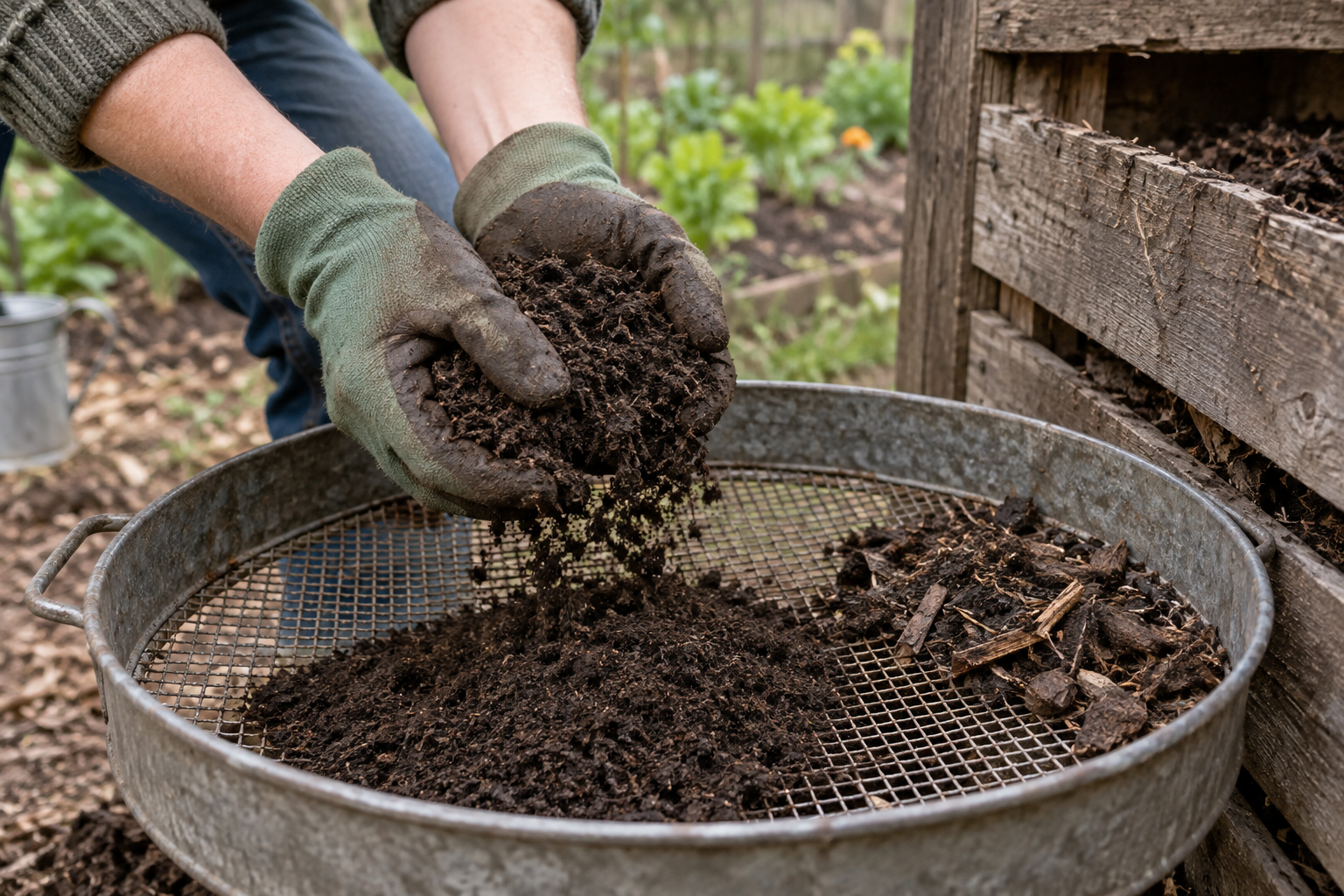
A garden sieve can separate coarse fragments from finer material. Return the larger woody pieces to an active pile if appropriate. Screening makes compost easier to spread, but it does not make immature compost mature or confirm that contaminants are absent.
Also keep maturity separate from sanitation. A pleasant smell and dark texture do not prove that a home pile reached conditions needed to control weed seeds or pathogens. What you put into the bin and how you managed it still matter.
Let the intended use guide your patience
Seedlings and containers leave less room for mistakes than an established garden bed. Avoid treating uncertain compost as a complete potting medium, and follow a suitable growing-mix recipe rather than planting directly into a questionable batch.
If the signs disagree, leave the material to continue processing and check again. A useful harvest decision sounds like this: the batch is mostly unrecognizable, smells earthy, has suitable moisture, behaves consistently, and has had time to cure. That is a stronger basis for garden use than “it finally looks dark.”