Currency & Forex Markets Explained: What Moves Exchange Rates and Why It Matters
Understanding the Currency & Forex Market
The foreign exchange market, commonly called the forex or FX market, is the global marketplace where currencies are bought and sold. It is the largest financial market in the world, with daily trading volumes measured in trillions of dollars. Unlike stock exchanges that operate through centralized venues, forex trading takes place over the counter through a network of banks, brokers, institutions, corporations, and individual traders across different time zones.
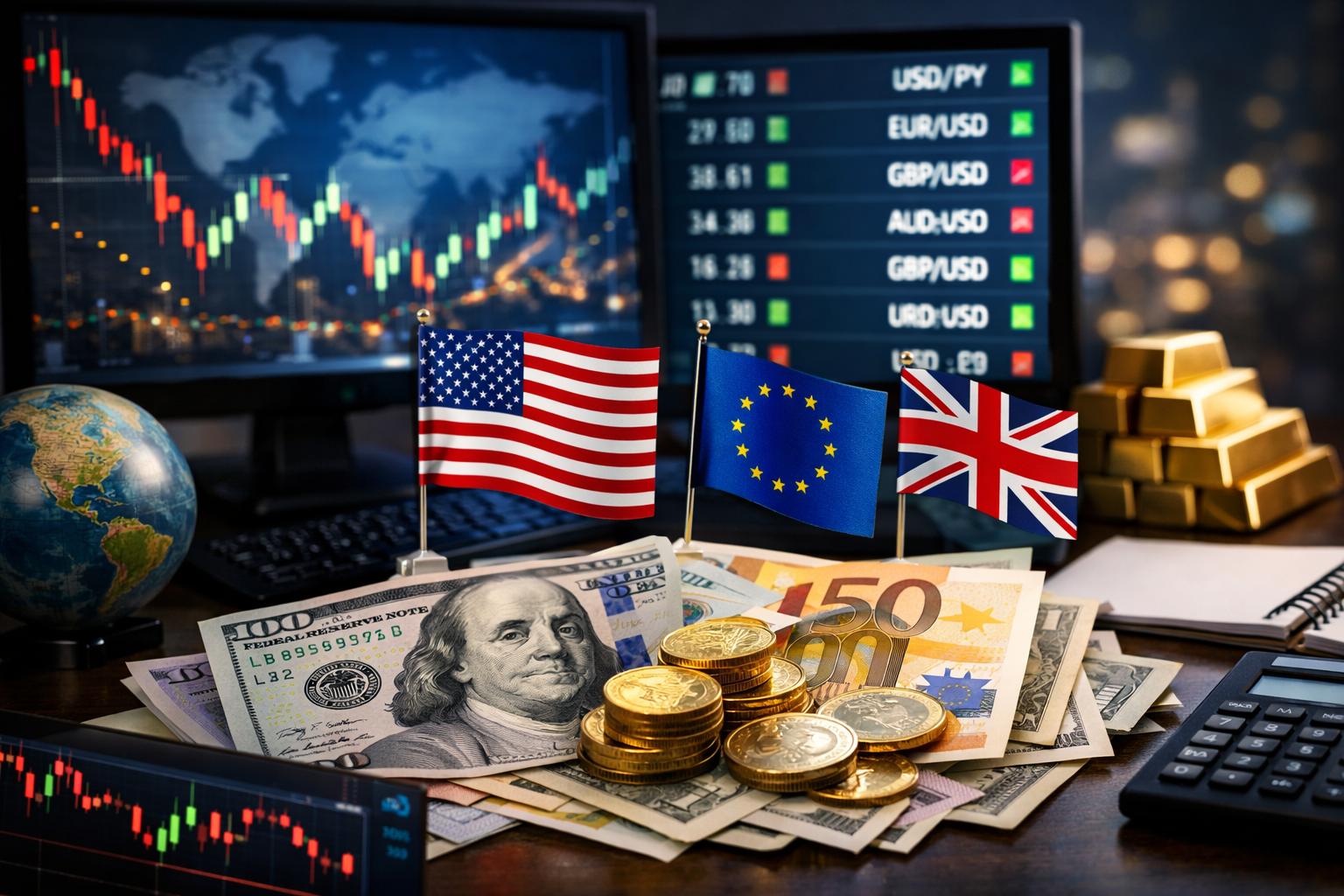
Currencies are quoted in pairs, such as EUR/USD or USD/JPY. In each pair, the first currency is the base currency and the second is the quote currency. If EUR/USD is trading at 1.10, it means one euro can be exchanged for 1.10 US dollars. Price movements in these pairs reflect changing expectations about economic conditions, interest rates, inflation, trade flows, and geopolitical developments.
Why Forex Matters Beyond Trading
The forex market is not just for professional speculators. It plays a vital role in the global economy. Multinational companies use it to convert revenue and pay suppliers in foreign markets. Governments and central banks monitor currency strength because it affects inflation, trade competitiveness, and financial stability. Travelers encounter forex rates whenever they exchange money for a trip abroad.
For investors, currencies can influence the performance of international portfolios. A strong local currency can reduce the value of overseas returns when translated back home, while a weaker one can boost export-oriented companies. Because of this, currency trends often matter far beyond the FX market itself.
Key Drivers of Exchange Rates
Interest Rates and Central Bank Policy
Among the most important drivers of currency values are interest rates and expectations around monetary policy. When a central bank raises rates, it can make that country’s assets more attractive to investors seeking yield, which may strengthen the currency. Conversely, lower rates can reduce demand for a currency.
Markets pay close attention not only to actual rate decisions, but also to central bank guidance. Statements from the US Federal Reserve, the European Central Bank, the Bank of England, and the Bank of Japan can move currencies sharply within minutes.
Inflation and Economic Growth
Inflation affects purchasing power and shapes central bank decisions. Persistent inflation may lead to tighter monetary policy, while weak inflation can encourage stimulus. Economic growth data, including GDP, employment reports, retail sales, and manufacturing activity, also influence market sentiment. Stronger-than-expected data can support a currency if traders believe it will lead to higher rates or stronger capital inflows.
Political Risk and Geopolitics
Elections, trade disputes, wars, sanctions, and political instability can all create volatility in currency markets. Investors generally prefer stability and predictable policy environments. When uncertainty rises, capital may shift toward perceived safe-haven currencies such as the US dollar, Swiss franc, or Japanese yen.
Trade Balances and Capital Flows
Countries that export more than they import may experience steady demand for their currency, although the relationship is not always simple. Capital flows, including foreign direct investment and portfolio investment, can have an even larger short-term impact. If global investors view a market as attractive, they may buy local assets and support the domestic currency.
Major, Minor, and Exotic Currency Pairs
Forex pairs are often grouped into three broad categories:
- Major pairs: The most actively traded pairs, typically involving the US dollar, such as EUR/USD, USD/JPY, and GBP/USD.
- Minor pairs: Pairs that do not include the US dollar but feature major global currencies, such as EUR/GBP or AUD/NZD.
- Exotic pairs: A major currency paired with one from a smaller or emerging economy, such as USD/TRY or EUR/ZAR.
Major pairs usually offer higher liquidity and tighter spreads, while exotic pairs may present larger price swings and higher transaction costs.
How Participants Use the Forex Market
Different market participants enter the forex market for different reasons. Commercial banks facilitate transactions and manage liquidity. Hedge funds and asset managers take positions based on macroeconomic views or portfolio strategy. Corporations hedge foreign exchange exposure to reduce uncertainty in cash flows. Retail traders often seek short-term opportunities through leveraged instruments.
Hedging is especially important for businesses exposed to multiple currencies. For example, an importer paying overseas suppliers may use forward contracts to lock in exchange rates and protect profit margins. Without such risk management, sudden currency moves can materially affect earnings.
Risks and Challenges in Forex
Although forex offers deep liquidity and around-the-clock trading during the business week, it also carries significant risk. Currency prices can react quickly to economic releases and unexpected political events. Leverage, while potentially magnifying gains, can also amplify losses. This is one reason risk management is essential.
Common challenges in forex include:
- Sharp volatility around central bank announcements
- Overreliance on leverage
- Unexpected gaps during geopolitical events
- Misreading economic data or policy signals
- Liquidity differences between major and exotic pairs
Traders and investors often use stop-loss orders, position sizing rules, and diversification to help manage these risks. For businesses, treasury planning and hedging programs can reduce exposure to unfavorable moves.
Technology and the Evolution of FX Trading
Technology has transformed the currency market. Electronic trading platforms have increased access, reduced execution times, and improved price transparency. Algorithmic trading and high-frequency strategies now account for a meaningful share of activity in major currency pairs. At the same time, mobile apps and online brokers have made forex more accessible to individual participants.
However, greater access does not guarantee better outcomes. Success in currency markets still depends on discipline, clear strategy, and a strong understanding of macroeconomic forces. Fast execution can be useful, but informed decision-making remains the real advantage.
The Bottom Line
Currency and forex markets sit at the center of global finance. They connect trade, investment, monetary policy, and geopolitical risk in real time. Exchange rates move for many reasons, but the most influential drivers usually include interest rates, inflation trends, growth expectations, and capital flows.
Whether you are an investor evaluating international exposure, a company managing global payments, or simply someone trying to understand why a currency is rising or falling, forex knowledge offers valuable insight. In a deeply interconnected world, currency movements are not just market signals—they are reflections of how economies compete, adapt, and respond to change.