Mary Anning’s Expertise Extended Far Beyond Finding Fossils
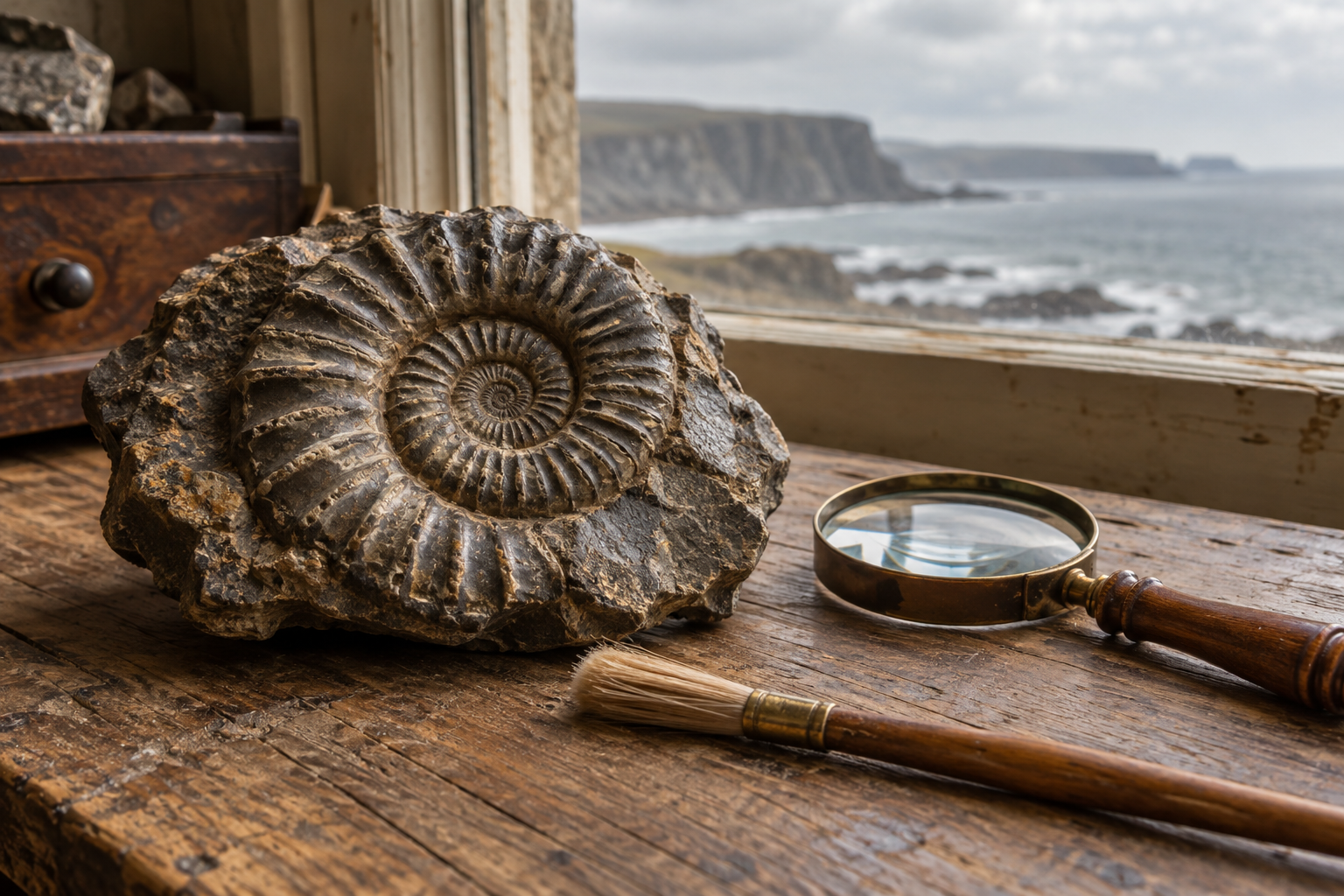
Calling Mary Anning a fossil finder describes an achievement while leaving much of the work out of view. Finding a visible bone was only one stage. Recognizing its importance, locating the rest, removing surrounding rock, and understanding where it belonged all required judgment.
Anning’s career in Lyme Regis makes that distinction unusually clear. Her discoveries supplied evidence for nineteenth-century discussions of ancient life, while visiting geologists also depended on knowledge she had developed along a small stretch of coast. Her expertise was practical, intellectual, and commercial at once.
A family livelihood on the Dorset coast
Anning was born in Lyme Regis in 1799. Her father, Richard, worked as a carpenter and cabinetmaker and supplemented his earnings by selling fossils. Mary learned collecting skills from him. When he died in 1810, the family faced debts, and the fossil trade became an important means of support.
This background matters because it changes the familiar picture of a gifted child wandering a beach. Fossils were things to study, but they were also goods that needed buyers. Collecting demanded labor before anyone knew whether a specimen would repay it.
Her formal schooling was limited, but limited schooling should not be confused with an absence of learning. She could read and write and developed knowledge of geology and anatomy. The work itself brought repeated encounters with forms that were difficult to recognize from scattered fragments.
Discoveries that made unfamiliar animals tangible
In 1811, her brother Joseph found a fossil skull. Mary subsequently uncovered the associated skeleton, an important early ichthyosaur specimen. Ichthyosaurs were marine reptiles; describing them simply as dinosaurs confuses different groups of ancient animals.
Her celebrated plesiosaur discovery followed in December 1823. Its long neck and unfamiliar proportions made it a striking challenge for interpretation. The specimen gave researchers a much more complete basis for understanding an animal previously known from less satisfactory evidence.
William Daniel Conybeare presented his account in 1824. The Geological Society’s archive records an unexpectedly practical obstacle: the large specimen could not be carried up the narrow stairs to the meeting room. It had to be displayed in the hallway. Even a scientific landmark remained a heavy physical object that someone had to transport and handle.
Anning also found a pterosaur in 1828. Pterosaurs were flying reptiles, another group distinct from dinosaurs. The range of her discoveries shows why reducing her career to a single famous skeleton is misleading.
Knowing where the bones belonged
A visit recorded by Roderick Murchison in September 1825 offers a closer view of her working knowledge. He and his wife, Charlotte, visited the family’s shop, where Anning’s mother also demonstrated familiarity with the fossils. The business drew on more than one person’s labor and experience.
Murchison then encountered Mary searching on the shore. His diary noted her understanding of the different fossil-bearing beds: layers of rock associated with particular remains. That knowledge helped connect a specimen to a place within the local geology.
The account also describes the expense of hiring workers to excavate a large fossil and the uncertainty of a promised purchase. A remarkable find did not automatically become income. Money could be committed to recovering an object before a buyer completed the transaction.
When Murchison returned after continuing his travels, Anning gave him a tour of the local geology. This is a useful correction to the idea that knowledge moved only from formally recognized scientists toward collectors. Here, the collector was also a guide and teacher.
From specimens to scientific reconstructions
Anning’s fossils could support work far beyond the place where she found them. An ichthyosaur specimen she supplied, acquired for the Bristol Institution, was central to a skeletal reconstruction published by Conybeare in 1824. A recovered fossil became evidence from which an animal’s structure could be argued and illustrated.
That process involved several kinds of contribution. Locating and preparing a specimen made later anatomical comparison possible. Drawing, describing, and publishing it brought the evidence into scientific discussion. A history concerned only with the final paper risks losing the earlier stages that enabled it.
Recognition and belonging were different things
Anning was known to important geologists, yet she could not join the Geological Society because it excluded women. Contact with influential researchers did not give her the same institutional standing they enjoyed. Scientific usefulness and professional inclusion were separate matters.
She died in 1847. Her surviving specimens and the records of those who consulted her allow a more substantial account than either an isolated childhood discovery or a simple story of eventual fame.
Anning’s career asks us to notice expertise where the evidence places it: in careful observation, skilled preparation, local understanding, and the ability to help others see what they had not yet understood. The fossil in a museum case is the visible result. Her knowledge was part of how it became evidence.