Why a Metal Spoon Feels Colder Than a Wooden One
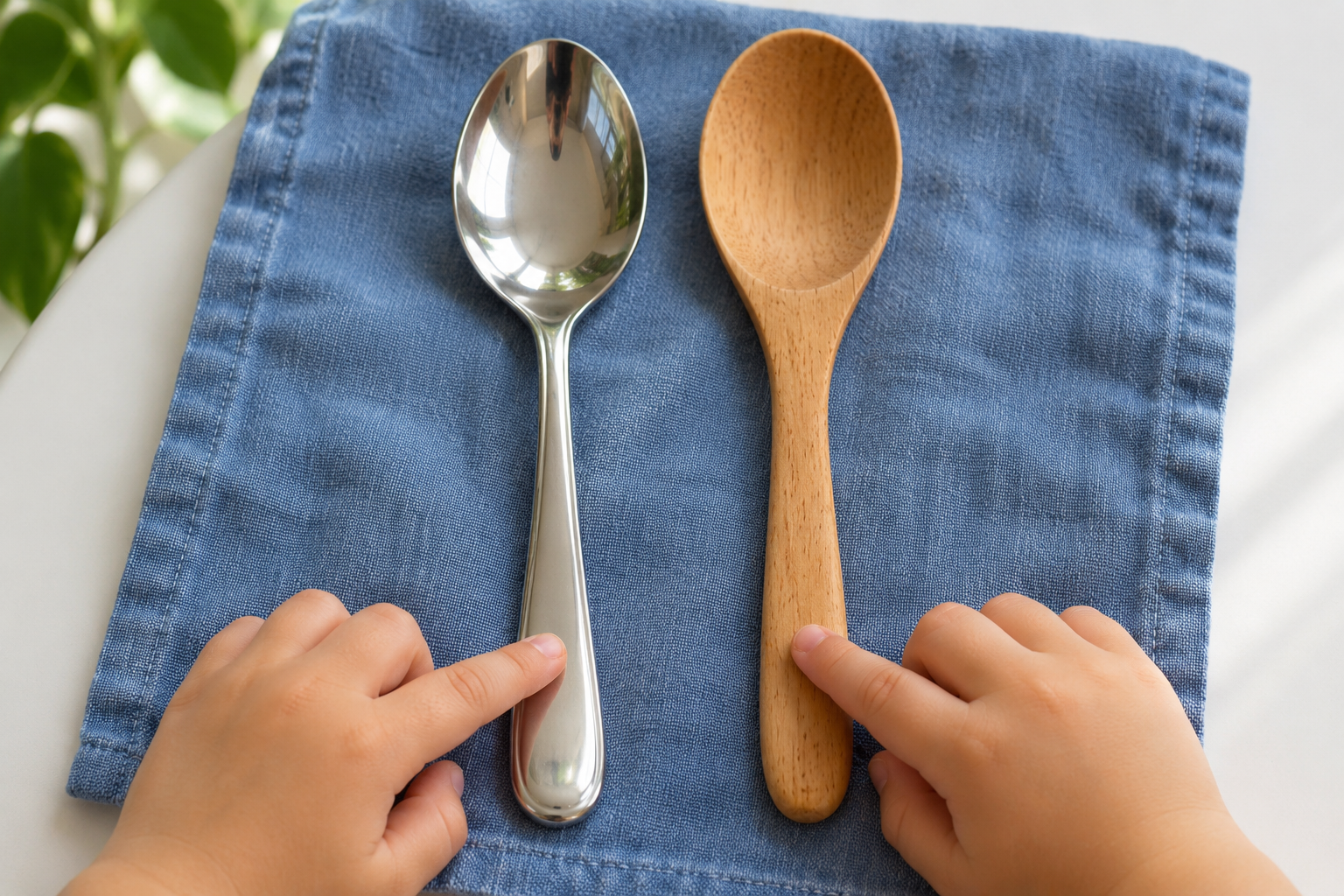
Put a metal spoon and a wooden spoon beside each other in an ordinary room. After they have had time to settle to the room’s conditions, touch their handles. The metal will usually feel colder, even though both objects can be at essentially the same temperature.
The surprise comes from what your hand is sensing. Your skin responds to heat moving into or out of it. A metal surface can carry heat away from your warmer hand more readily than wood, producing a stronger feeling of cold without starting at a lower temperature.
Temperature and heat flow describe different things
Temperature tells us how hot or cold an object is. Heat flow describes energy moving because of a temperature difference. When your hand is warmer than a spoon, energy moves from the warmer hand toward the cooler spoon.
Metal is a good thermal conductor: heat moves through it relatively easily. Wood is a poorer conductor. As your fingertip warms a small contact area on the metal, heat can spread away through the object. With wood, that transfer is slower, so the contact can feel less cold.
The spoon has not sent a substance called cold into your finger. Your finger is losing heat. Keeping the direction of that transfer clear helps explain the sensation without inventing an extra kind of energy.
Try a room-temperature comparison
For a beginner’s investigation, choose a smooth metal spoon and a smooth wooden spoon that are comfortable to touch. Use ordinary room conditions only. Ask an adult to help select the objects and check that there are no sharp or splintered surfaces.
Leave them together on a table away from sunlight, radiators, cooking appliances, and drafts. Do not use a spoon that has just come from a dishwasher, cold cupboard, hot drink, or refrigerator. Give both time to settle before beginning.
- Predict which handle will feel colder and write down why.
- Touch each handle briefly with a fingertip using similar pressure.
- Record what you felt before discussing an explanation.
- Swap which hand touches which material and repeat.
Try to compare similar parts of the handles. Gripping a large metal bowl with your whole palm and touching a tiny wooden tip with one finger changes more than the material. That makes the result harder to interpret.
Write the observation before the conclusion
A useful observation is “The metal felt colder to my finger.” A different statement, “The metal had a lower temperature,” requires a temperature measurement. The first does not automatically prove the second.
Make two columns in a notebook: what you noticed and what might explain it. In the first, record the sensation. In the second, write that faster heat transfer from your skin could explain it. This small distinction is a useful scientific habit far beyond the spoon experiment.
If suitable contact-temperature equipment is available, an adult can help compare the objects’ temperatures. Follow the instrument’s instructions and allow the reading to settle. You do not need a thermometer to notice the sensory difference, but touch alone cannot establish an exact temperature.
Why the setup matters
Two objects in the same room are not always at the same temperature. One may have been in direct sunlight, recently handled, or placed beside something warm. Saying “They were indoors” does not rule out those differences.
The comparison also involves more than a material name. Shape, thickness, surface finish, and the area touching your skin can affect what you feel. The experiment illustrates a principle; it is not a precise ranking of every metal and every kind of wood.
If your observations seem inconsistent, check those conditions before assuming the idea has failed. Perhaps one spoon was held for longer before the test. Reset the objects and describe the uncertainty honestly rather than changing the notes to match the expected answer.
Metal can feel especially hot as well
The same ability to transfer heat works in the other direction. When a metal object is hotter than your hand, heat can move into your skin quickly. Good conduction is therefore not a special ability to make things cold.
Keep this part as an explanation, not another touch experiment. There is no need to heat or freeze the spoons to understand the reversal. Room-temperature objects already provide the comparison without deliberately creating a burn or cold-injury risk.
You may recognize the idea in everyday experiences, such as different floor materials feeling different under bare feet. Before deciding that one surface must have a lower temperature, remember the two spoons. A strong sensation tells you something about your body’s exchange of heat; it does not, by itself, give the object’s thermometer reading.