A Refill Pouch Needs a Fair Comparison, Not Just a Green Label
A pouch says it uses less plastic. Beside it sits a bottle described as reusable. Both claims may be relevant, but neither tells you the result for the amount of product your household will actually use.
A fair comparison needs a defined alternative and a common quantity. It also needs a clear boundary: are you comparing packaging weight, plastic content, cost, or the environmental impact of the whole system? These are related questions, but they do not produce interchangeable answers.
Ask what the percentage is compared with
A claim of “less packaging” needs a baseline. It might compare the pouch with the manufacturer’s previous bottle, a larger container, or a bottle holding a different quantity. Look for the explanation that makes the claim meaningful.
Also check which components are counted. A bottle’s pump, cap, sleeve, and outer carton may be treated differently in different comparisons. A statement about plastic alone does not necessarily describe the total weight of a package that also contains other materials.
You do not need to assume a claim is false when the explanation is incomplete. You do need to recognize what remains unknown. A specific, limited claim is easier to evaluate than a broad promise that a product is simply good for the planet.
Match the amount of useful product
Comparing one pouch with one bottle can mislead when they contain different amounts. Put both alternatives on the same basis, such as packaging used to supply four litres of ready-to-use product.
For a concentrate, the relevant quantity may be the usable product after dilution according to instructions. For a product measured by doses, compare the same number of correctly measured uses. Do not assume a large container provides more useful service merely because its volume is larger.
Keep product suitability in the comparison as well. Buying a format you cannot store, dispense, or use as intended can create waste that a package-weight calculation does not capture.
Work through a fictional example
Suppose a conventional 500-millilitre bottle has 80 grams of total packaging. Supplying four litres requires eight bottles, so the packaging adds up to 640 grams.
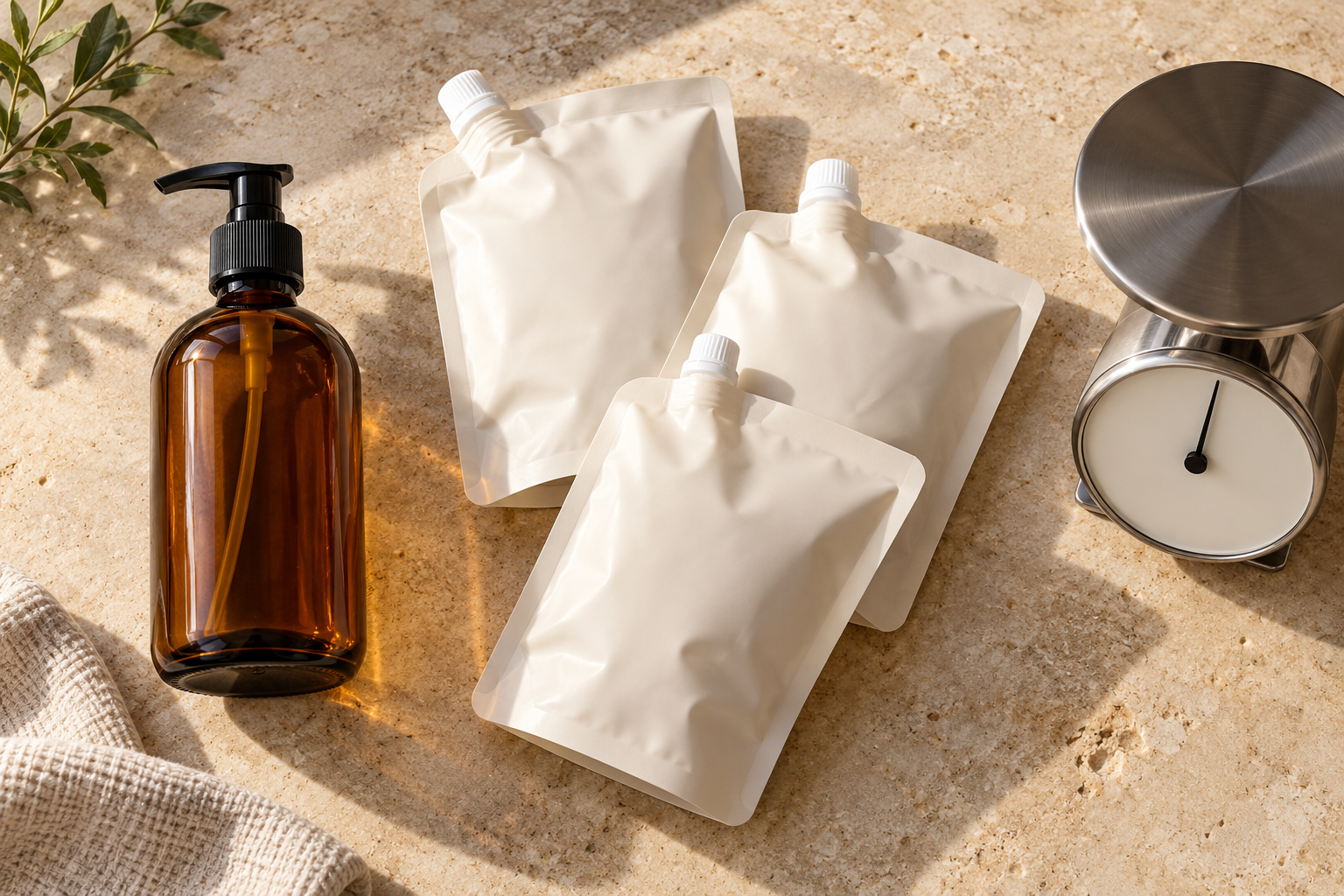
Now imagine an empty reusable dispenser weighing 120 grams and one-litre refill pouches weighing 20 grams each. Four pouches supply the same four litres. Counting the dispenser once and all four pouches gives 200 grams of packaging.
The difference is 440 grams, or 68.75 percent less packaging by weight across that defined comparison. These are invented figures for demonstrating arithmetic, not measurements of an available product.
The calculation depends on using the dispenser for the full amount assumed. If it breaks, is replaced for appearance, or is abandoned after one refill, the result changes. If it is already owned, an additional-purchase comparison may allocate its weight differently. State which question you are answering rather than switching methods halfway through.
Weight savings are one piece of the picture
The example measures packaging mass. It does not establish a matching percentage reduction in greenhouse-gas emissions, water use, or overall environmental harm. Producing different materials, transporting them, cleaning reusable components, and handling them after use all introduce other considerations.
A broader assessment needs evidence about those stages and clear assumptions about how often the container is reused. You cannot obtain that answer simply by placing the packages on a kitchen scale.
Similarly, a lightweight pouch and a readily collected rigid bottle present different end-of-life questions. Check local collection guidance for the exact packaging material and format. A recycling symbol or a general brand statement does not by itself confirm acceptance in your household collection.
Check whether refilling will work in practice
The practical system matters as much as the initial purchase. Find out whether refills are available in a quantity and location that suit you, whether the dispenser’s parts can be maintained, and what the manufacturer says about cleaning and compatibility.
- Use the intended refill and follow the product’s handling instructions.
- Keep required product identification and safety information available.
- Do not mix different products or transfer them into food or drink containers.
- Follow cleaning and drying directions rather than assuming every dispenser can be treated alike.
These checks are particularly relevant when the attractive reusable container is being sold separately. Its usefulness depends on an ongoing refill arrangement, not merely on whether its cap can be removed.
Choose the claim you can support
A careful conclusion might be that a particular refill system uses less packaging by weight for your expected consumption, under the stated assumptions. That is a useful finding without turning it into a universal verdict about every refill product.
Keep the durable container in service where appropriate, buy quantities you will use, and revisit the comparison if the packaging or refill arrangement changes. The strongest reason to choose a refill is an understandable system you can keep using, backed by a claim whose boundaries are clear.